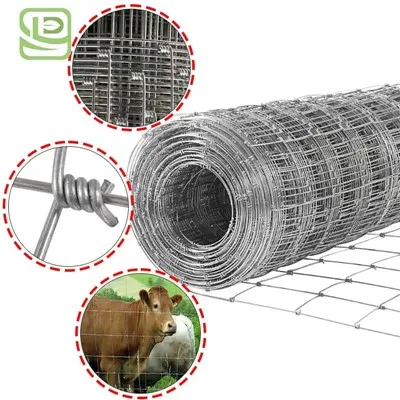
Products Description:
| Product Name | Galvanized Cattle Fence |
| Product Name | Fence Panel Cattle |
| Surface Treatment | Electiric Galvanized/Hot dipped galvanized |
| Usage | Protecting, Factory, Home Security, fencing mesh |
|
Sample |
Sample are free for customers |
| Place of origin | Hebei, China |
| Material | Iron Wire/Stainless Steels |
| Color |
Silver,etc |
| Length | 10-200m |
| Application | Agricultural, Farm field |
| Height | 0.6m-2.6m |


Application of Cattle Fence
Pasture Management
Dividing large grazing areas into smaller, controlled paddocks to optimize grass utilization and prevent overgrazing in specific zones.
Rotational Grazing
Systematically moving cattle between fenced paddocks to allow forage regrowth, improve pasture health, and increase carrying capacity.
Boundary Control
Defining property lines and preventing cattle from straying onto roads, neighboring properties, or into unsafe areas like waterways or cliffs.


Disease Control
Isolating sick or newly arrived animals (quarantine) within designated fenced areas to prevent the spread of illness to the main herd.
Infrastructure Protection
Keeping cattle away from sensitive areas like gardens, crops, orchards, fuel tanks, buildings, or environmental conservation zones.
Handling & Sorting
Creating secure pens, alleys, and chutes within handling facilities to safely gather, sort, load, vaccinate, or perform veterinary procedures on cattle.
Our Service
Pauleen provides you with the best quality products and services
01
Secured Trade Transactions
We manage contracts, payments, and documentation ensuring safe and reliable international deals.
02
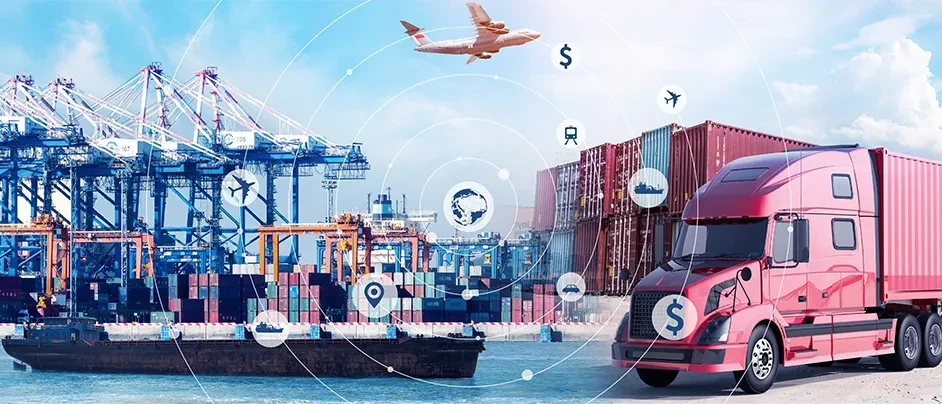
Streamlined Global Logistics
We handle shipping, customs clearance (FOB, CIF, etc.), and timely delivery efficiently.
03
Targeted Market Expansion
We identify opportunities and connect you with qualified international buyers for your products.

fAQ
1.Q: Which fencing type provides the greatest lifespan for cattle confinement?
A: High-tensile (HT) steel wire or mesh fencing delivers superior longevity. These options outperform others in resisting livestock pressure, extreme weather, and physical stress. Proper installation and sustained tension are critical for maximizing durability.
2.Q: What barrier height effectively contains cattle?
A: Standard enclosures measure 4.5–5 feet (1.4–1.5 meters). Taller breeds like bulls or jumpers may require 5.5–6-foot (1.7–1.8-meter) barriers. Position the bottom wire close to the ground to prevent calves from crawling under.
3.Q: What spacing is recommended between fence posts?
A: Separate line posts by 8–16 feet (2.5–5 meters), varying with terrain and fence style (closer spacing on uneven ground). Anchor posts (corners/braces) must withstand significant load; install deep-set H-braces or diagonal reinforcements.
4.Q: Are electric fences dependable for cattle containment?
A: Yes, when properly configured. Effective deterrence requires maintaining 2,000–4,000 volts. Polywire/tape or electrified HT lines suit rotational grazing well. Ensure effective grounding (install ≥3 rods in moist soil) and conduct routine voltage checks.
5.Q: How do I prevent cattle from leaning on or damaging fences?
A: Install electrified wires at snout level (e.g., a single offset wire 6–12 inches inside the primary fence). Use robust materials (steel or timber posts) in high-traffic areas. Provide ample feed/forage access away from perimeter lines to reduce crowding or fence-testing behavior.
Hot Tags: galvanized cattle fence, China galvanized cattle fence manufacturers, suppliers, factory, Cattle Fence Panel, Cattle Yard Fence, Galvanized Cattle Fence, Galvanized Cattle Welded Wire Mesh Panel Fence