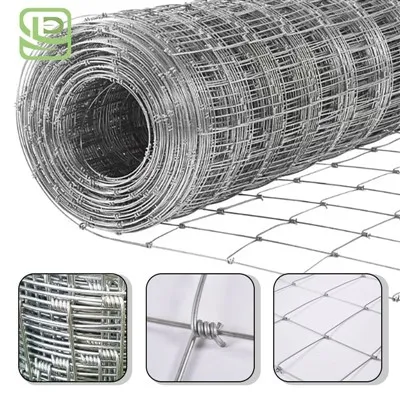
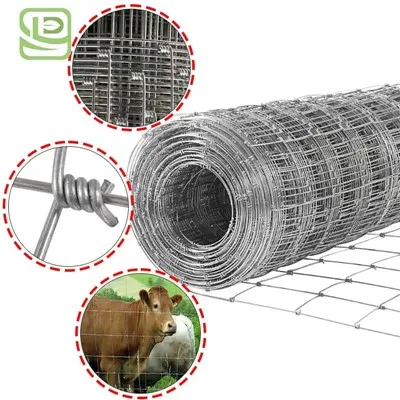
Products Description :
| Product Name | Cattle Corral Fence |
| Surface Treatment | Electiric Galvanized/Hot dipped galvanized |
| Usage | Protecting, Factory, Home Security, fencing mesh |
|
Sample |
Sample are free for customers |
| place of origin | Hebei, China |
| Material | Iron Wire/Stainless Steels |
| Color |
Silver,etc |
| Length | 10-200m |
| Application | Agricultural, Farm field |
| Height | 0.6m-2.6m |
advantage of Cattle Fence


Protects cattle from external threats like predators (coyotes, wolves) and major hazards (traffic, cliffs), while also reducing the risk of theft.


Facilitates biosecurity by restricting contact with outside animals (reducing disease transmission) and helps control internal parasites through strategic pasture rotation.


Cattle Fence applications

Livestock Containment
Keeping cattle securely within designated pastures or property boundaries.

Predator Protection
Creating barriers to deter wild animals (wolves, coyotes) and stray dogs from attacking cattle.

Rotational Grazing Management
Dividing large pastures into smaller paddocks to control grazing patterns, promote grass regrowth, and optimize forage use.

Animal Separation/Grouping
Isolating specific animals (sick, injured, calving) or segregating groups (bulls, calves, different herds) for management, safety, or health reasons.
Our company

fAQ
1. Q: What fencing components maximize lifespan in permanent cattle containment structures?
A: Integrating robust high-tensile woven wire with corrosion-resistant timber or treated metallic posts ensures superior structural integrity. This synergy significantly extends operational longevity for mature bovine enclosures.
2. Q: Recommended vertical dimensions and wire positioning for livestock perimeter fencing?
A: Adult cattle enclosures mandate a minimum height of 54 inches. Foundational layout principles:
Base grid spacing: 4-6" to deter calf passage, using gradually increasing spacing upward
Electrified setups: Conventional 3-5 wire arrangements; lowest wire installed 20-30" above terrain
3. Q: Is electrified perimeter fencing effective for livestock management?
A: Properly deployed electric fences deliver reliable containment through potent, safe deterrent pulses. Common conductors feature polymer-based materials (polywire/tape) or rigid high-tensile steel. Consistent performance requires adequate energizer output (PSI), optimized grounding, and rigorous vegetation control-particularly advantageous for managed grazing and pasture segmentation.
4. Q: Upkeep procedures for perimeter fencing infrastructure?
A: Perform biannual and post-inclement weather evaluations, checking for:
Conductor impairment or faulty junctions
Damaged posts (deteriorated timber, deformed metal)
Structural deviation or slackening
Vegetation touching charged components
Static barriers necessitate less maintenance than active systems, which demand weekly growth suppression and energizer verification during high-growth periods.
5. Q: Key cost drivers in cattle confinement projects?
A: Primary expense contributors encompass:
Material selection: Woven wire costs surpass barbed wire; sophisticated electric systems involve greater upfront expenditure
Components: Post material (e.g., metal/timber/composite), conductor variety, insulators (live systems), entryways, reinforcement elements
Project scale: Total linear enclosure footage
Terrain complexity: Rocky, inclined, or forested sites elevate labor requirements
Installation approach: DIY versus contractor implementation
Supplementary features: Power supplies (battery/solar), end assemblies, specialized gate configurations
Hot Tags: cattle corral fence, China cattle corral fence manufacturers, suppliers, factory, Cattle Fence Panel, Cattle Yard Fence, Galvanized Cattle Fence, Galvanized Cattle Welded Wire Mesh Panel Fence