





Products Description:
| Product Name | Portable Padel Court |
| Material | Steel |
| Sample | Sample are free for customers |
| Color | Custmized |
| Delivery Time | 20-25Days |
| Place Of Origin | Hebei, China |
| OEM Service | Welcome(SPECIAL PRICE FORBIG ORDER) |
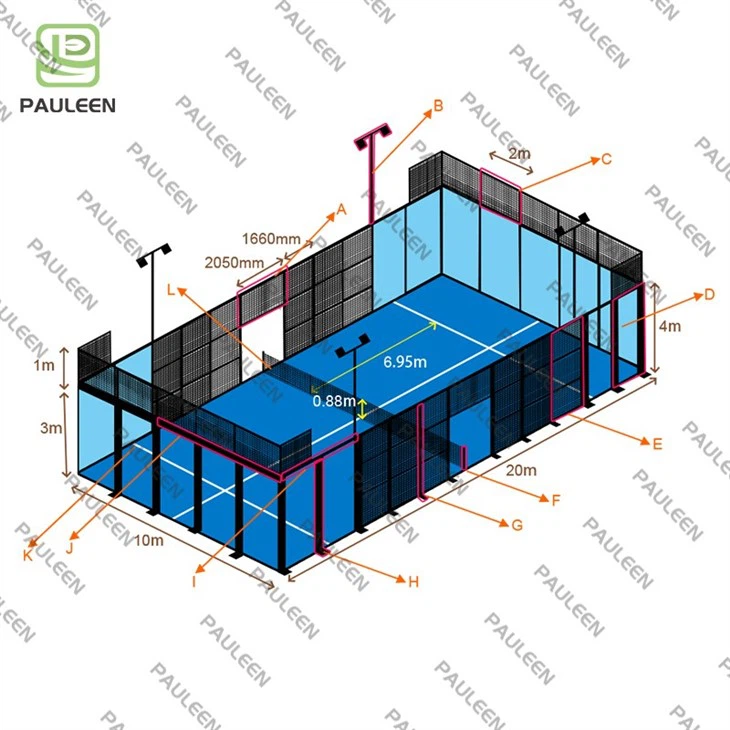
| Width | 10M |
| Length | 20M |
| Packaging | Acception Customized |


Precautions for use
Verify Door Latching
Make certain all access doors to the court are completely shut and secured before play commences. This prevents them from unexpectedly opening during a point, which could lead to accidents or disrupt the game.
Inspect for Moisture
Refrain from playing on the synthetic turf when it is damp or slippery. Such conditions greatly elevate the chance of players slipping and suffering strains or impact injuries.
Avoid Net Posts
Stay conscious of the metal posts supporting the net, which are situated near the action. Players should take care not to run into them during quick volleys or movements at the net.
Refrain from Wall Climbing
Never attempt to scale or put weight on the glass panels or metal fencing. These structures are engineered to absorb ball strikes, not to bear human weight. Always wear appropriate footwear to help preserve the playing surface.
Maintenance Guide
Court Dimensions
The footprint of a padel court is notably more compact than that of a tennis court. At a regulation size of 20 meters by 10 meters, it needs about one-third of the area a singles tennis match requires; this confined space fosters rapid exchanges and instinctive shot responses, given the smaller surface to cover.
Wall Integration
Unlike the open design seen in tennis, a padel venue is surrounded by a mix of glass panes and wire mesh. These elements are actively incorporated into play, allowing athletes to rebound the ball off them, akin to squash; this dynamic introduces a strategic dimension that traditional tennis lacks.
Surface and Ball Traits
Padel matches are played strictly on synthetic grass, while tennis features variety such as clay, lawn, or asphalt courts. Furthermore, the ball used in padel has reduced internal air pressure relative to a tennis ball, resulting in a more contained bounce and controlled speed, highlighting accuracy and finesse over raw force.
Serving Technique
The way a point begins also marks a significant contrast. Tennis requires an overhand serve delivered with substantial force. Conversely, padel mandates an underhand serve, where the ball is hit after a bounce and below waist level, making the start of a rally significantly less aggressive.
Hot Tags: portable padel court, China portable padel court manufacturers, suppliers, factory


