




Products Description:
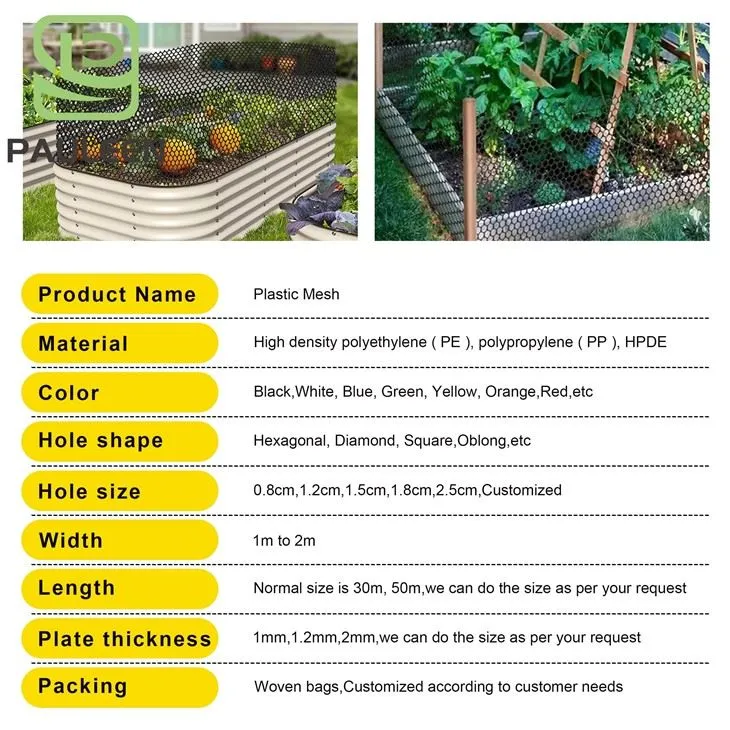
| Product Name | Plastic Mesh Garden Fencing |
| Material | High Density Polyethylene/Polypropylene/Polyethylene |
| Packing | Woven bags,Customized according tocustomer needs |
|
Sample |
Sample are free for customers |
| Width | 1m-2m |
| Length | 30m/50m/Customized |
| Color |
Black,Blue,Yellow,Red,etc |
| Sample | Sample are free for customers |
| Hole size | 0.8cm/1.2cm/1.5cm/1.8cm/2.5cm/Customized |
| Plate thickness | 1mm,1.2mm,2mm,we can do the size as per your request |
advantage of Plastic Mesh


Plastic applications

Boundary Fortification
Establishing protective barriers and defining operational zones.

Product Securement
Stabilizing merchandise and designing versatile packaging.

Erosion Control
Anchoring soil strata and preventing terrain degradation.

Structural Integrity Enhancement
Fortifying concrete resilience and ensuring framework support.
Our company

fAQ
1.Q: What polymer varieties are commonly employed in plastic mesh production?
A: Core materials include Polyethylene (HDPE/LDPE), Polypropylene (PP), Polyvinyl Chloride (PVC), and Nylon. Selection hinges on application-specific demands for mechanical properties, chemical resistance, UV stability, and cost-effectiveness.
2.Q: How does plastic mesh tolerate exposure to weather and external environments?
A: Most plastic mesh demonstrates exceptional environmental resilience, enduring moisture, precipitation, and thermal variations. HDPE and PP formulations often integrate UV inhibitors to prevent sunlight-induced deterioration and brittleness. These substances also resist biological decay, fungal growth, and corrosive agents.
3.Q: Which industries predominantly use plastic mesh?
A: Its versatility enables broad implementation across sectors:
Horticulture/Landscaping: Erosion control fabrics, trellising systems, tree guards, boundary markers
Building Sector: Scaffolding debris nets, safety fencing, plaster reinforcement, drainage core grids
Industrial Applications: Filter screens, separation meshes, screen-printing substrates, ventilation grilles
Farming: Crop protection barriers, animal enclosures, forage retention nets
Commercial Environments: Product packaging sleeves, exhibition frameworks, storage compartmentalizers
Creative Works: Sculptural installations and artisan crafts
4.Q: Which criteria govern plastic mesh specification and attribute selection?
A: Key determinants encompass:
Opening Geometry: Mesh size (e.g., ¼", ½") governing retention efficiency, filtration accuracy, or transparency
Strand Thickness: Increased filament diameter enhances stiffness and weight-bearing capacity
Resin Selection: Determined by operating conditions, performance thresholds, and chemical contact (see FAQ1)
Dimensional Parameters: Necessary sheet or roll measurements
Operational Demands: Projected stress loads and service contexts
5.Q: What techniques facilitate efficient plastic mesh cutting and fitting?
A: Cutting: Demands heavy-duty tools-industrial scissors, tin snips, powered cutters, or reinforced knives. Score-and-snap methods work for rigid thin-gauge meshes. Safety equipment is essential to avoid injury from sharp edges.
Installation: Approach varies by function:
Fastening: Affix using cable ties, galvanized clips, fence staples (wooden supports), or polymer ropes. Secure fencing to posts.
Ground Application: Fix soil stabilization geomesh with earth anchors along perimeters.
Surface Fixation: Mechanically attach construction lath using fasteners before rendering.
Hot Tags: plastic mesh garden fencing, China plastic mesh garden fencing manufacturers, suppliers, factory, Plastic Pigeon Protection Mesh, Plastic Welded Wire Mesh, PVC Plastic Coated Welded Wire Mesh, Plastic Coated Mesh, Plastic Chicken Wire Mesh, Plastic Wire Mesh Polypropylene Net Roll


