


Short Description:
|
Product Name |
Barbed Wire For Fence |
| Place of Origin |
HEBEI, CHINA |
|
Sample |
Sample are free for customers |
|
Material |
Steel Wire/Iron Wire |
| Usage | Border Control,Livestock Containment,Perimeter Security |


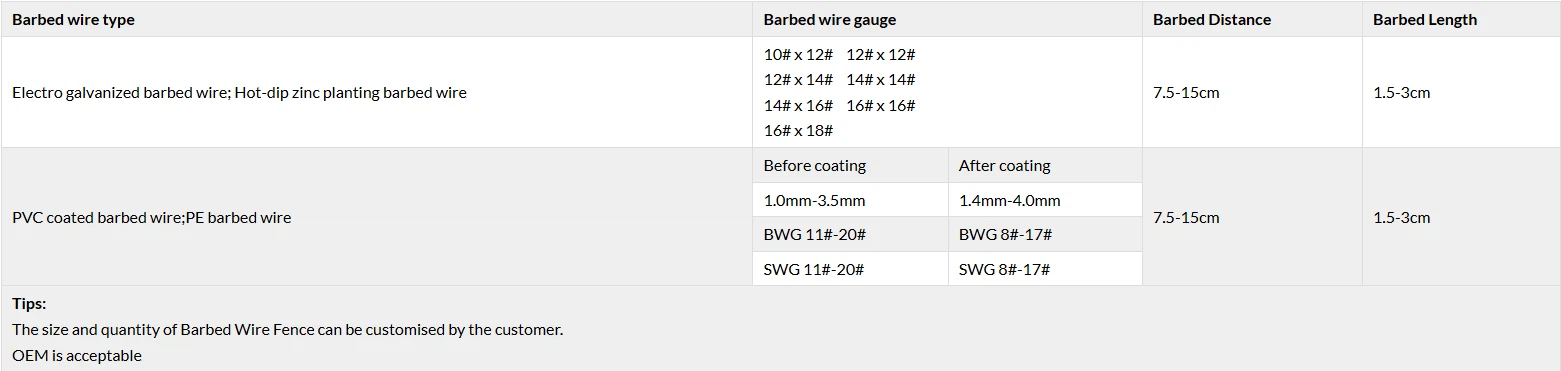
Barbed Wire For Fence Specification

fAQ
1.Q: What are the main purposes of using barbed wire for fencing?
A: Barbed wire is primarily used for security fencing and livestock containment. Its sharp points deter climbing and trespassing (humans and animals), making it ideal for perimeter security around properties, farms, prisons, industrial sites, and military zones. It also effectively contains large livestock like cattle within boundaries.
2.Q: What types of barbed wire are available, and what do "Class" ratings mean?
A: The main types are Single Strand (one line wire with barbs) and Double Strand (two line wires twisted together with barbs). "Class" refers to the gauge (thickness) of the steel wire used:
Class 1: Heaviest gauge (thickest wire), highest strength, longest lifespan. Best for permanent, high-security applications.
Class 3: Medium gauge. Common balance of strength, durability, and cost for general fencing.
Class 4: Lightest gauge (thinnest wire). Less durable, mainly for temporary fencing or light containment.
3.Q: Is barbed wire difficult to install?
A: Installing barbed wire requires careful planning and safety precautions due to the sharp barbs. Key steps include setting strong corner/end posts, installing sturdy line posts, using appropriate insulators (if near electric fences), applying high tension using tools like a come-along, and securely tying off the wire. Proper tension is crucial for effectiveness and longevity. While DIY is possible, professional installation is recommended for large areas, high-security needs, or complex terrain.
4.Q: Are there any legal restrictions or safety concerns with using barbed wire?
A: Yes, significant concerns exist:
Legal Restrictions: Many local municipalities and states/countries have regulations governing barbed wire use, especially near public property, sidewalks, or residential boundaries. Height restrictions, setback requirements, and prohibitions in certain zones are common. Always check local ordinances before installing.
Safety: Barbed wire poses serious injury risks (cuts, punctures, entanglement). Use warning signs ("Danger: Barbed Wire"), avoid placing it where people might accidentally contact it (e.g., low heights near paths), and ensure it's properly tensioned to prevent sagging hazards. Handle with heavy gloves and eye protection.
5.Q: How long does barbed wire fencing typically last, and how do I maintain it?
A: Lifespan depends heavily on:
Coating: Galvanized (zinc-coated) wire resists rust best and lasts the longest (15-30+ years). Aluminum-coated is also good. Uncoated ("bright") wire rusts quickly.
Class/Quality: Higher Class (thicker gauge) wire lasts longer.
Environment: Coastal/salty or highly acidic environments accelerate corrosion.
Tension & Installation: Proper tension and secure attachment prevent sagging and damage.
Maintenance: Regularly inspect for rust, broken strands, loose barbs, sagging, or damage from vegetation/impact. Repair or replace damaged sections promptly. Trim vegetation growing through the fence to prevent strain and corrosion. Re-tension sagging wire as needed.
Hot Tags: barbed wire for fence, China barbed wire for fence manufacturers, suppliers, factory, Barbed Steel Wire Mesh, Iron Wire Barbed Wire, Barbed Wire Roll, Galvanized Barbed Wire, Fencing Barbed Wire, Barb Wire Fence Roll


